
Underground garages and basement parking areas are often exposed to high humidity. Because these spaces are built below ground level, they usually have limited natural ventilation, lower surface temperatures, and continuous contact with surrounding soil and building structures.
When moisture is not properly controlled, an underground parking area can become damp, uncomfortable, and difficult to maintain. Condensation, musty odors, wet surfaces, and poor air circulation are common problems in underground garages.
A professional underground garage dehumidification solution helps maintain a drier, cleaner, and more stable environment for vehicles, building structures, equipment, and daily users.
Underground garages are naturally more likely to have humidity problems than above-ground spaces. Several factors contribute to this:
In many underground garages, humidity is not evenly distributed. Some areas may be relatively dry, while corners, storage zones, equipment rooms, and low-airflow areas remain damp.
High humidity in underground garages can cause several problems, including:
These problems can become more serious in rainy seasons, coastal areas, tropical climates, or buildings with poor underground ventilation design.
Underground garages are used for long-term vehicle parking. High humidity may contribute to moisture buildup around vehicles, tools, bicycles, motorcycles, and metal storage items.
Excess humidity may affect walls, ceilings, pipes, electrical rooms, and building materials. Condensation can also make underground structures harder to maintain.
Many underground garages include pump rooms, electrical rooms, mechanical rooms, or storage areas. These rooms often require more stable humidity control to protect equipment and improve maintenance conditions.
A damp underground garage can feel uncomfortable and unprofessional. For residential buildings, hotels, offices, apartments, and commercial buildings, a dry and clean garage environment improves the overall quality of the property.
Ventilation is important for underground garages, especially for exhaust air and general air exchange. However, ventilation alone may not solve humidity problems.
If outdoor air is humid, bringing more air into the underground garage can increase indoor moisture load. In some climates, especially during summer or rainy seasons, outdoor air may contain more moisture than the underground space can handle.
Dehumidification directly removes moisture from indoor air. For underground parking areas, a complete air control strategy may include:
A well-designed system should balance ventilation and dehumidification instead of relying on only one method.
Underground garage dehumidifiers should be selected based on space size, humidity load, airflow conditions, drainage availability, and installation requirements.
Important equipment requirements include:
For large underground parking areas, small residential dehumidifiers are usually not enough. Commercial or industrial dehumidifiers are often required.
Different underground garages may require different dehumidification system types.
Floor standing industrial dehumidifiers are suitable for large underground garages, commercial parking areas, building basements, and high-moisture spaces. They provide strong moisture removal capacity and large airflow.
They are useful when the project needs powerful humidity control and has enough equipment installation space.
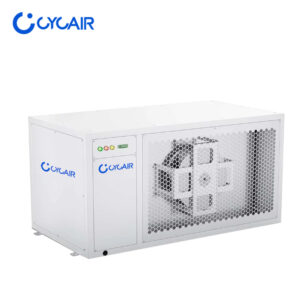
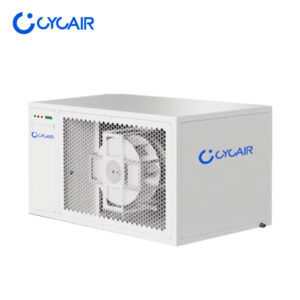
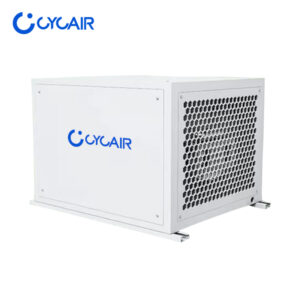
Ceiling mounted dehumidifiers are suitable when floor space is limited or when the equipment needs to be installed in a more integrated way. They can be used in underground garages, basements, storage areas, and commercial building projects.
Ceiling mounted solutions can help save usable floor area and support fixed installation.
Mobile industrial dehumidifiers can be useful for temporary moisture control, local damp areas, maintenance zones, or flexible building management needs.
For underground garage dehumidification, Cycair offers multiple product options depending on project size and installation requirements.
For large underground parking areas, DMC-A Series Floor Standing Industrial Dehumidifiers can be considered for high-capacity moisture removal and large-space humidity control.
For ceiling or concealed installation, DCM-A Series Ceiling Mounted Dehumidifiers can be used in underground garages, basements, and commercial underground spaces.
For flexible or local moisture control, DP-E Series Industrial Portable Dehumidifiers and DP-F Series Industrial Portable Dehumidifiers are suitable for underground rooms, garage areas, storage spaces, and temporary humidity control.
For larger underground parking areas, high-capacity models from the DMC-A Series, such as DMC-A480L, DMC-A600L, DMC-A960L, or DMC-A1440L, can be considered based on project size and humidity load.
Underground garage dehumidification solutions are suitable for:
The best solution depends on the garage size, humidity level, drainage condition, airflow layout, and installation method.
Underground garages are often humid because of limited ventilation, ground moisture, cooler wall and floor surfaces, outdoor humid air, and poor airflow in enclosed areas.
Ventilation helps with air exchange, but it may not reduce humidity if outdoor air is humid. Dehumidification is often needed to remove moisture directly from indoor air.
Large underground garages usually need industrial or commercial dehumidifiers. Floor standing, ceiling mounted, or mobile units can be selected depending on project size and installation conditions.
Need humidity control for an underground garage or parking area?
Contact Cycair with your space size, humidity problem, drainage condition, and installation requirements. Our team can help recommend a suitable dehumidification solution for your underground parking project.