
Commercial cannabis grow rooms are more demanding than ordinary indoor spaces. They are designed to support plant growth under controlled temperature, humidity, lighting, airflow, and irrigation conditions.
Among these environmental factors, humidity is one of the most difficult to manage. A commercial grow room can generate a large amount of moisture every day through plant transpiration and irrigation. If this moisture is not removed efficiently, the room may become unstable and harder to control.
This guide explains what makes commercial grow room dehumidification different, what buyers should consider, and what type of equipment is suitable for professional cultivation projects.
A commercial grow room usually has high plant density, controlled lighting, irrigation systems, and limited air exchange with the outside environment. In many cases, grow rooms are sealed or semi-sealed to improve environmental control.
This creates a high-moisture environment. Standard dehumidifiers are usually not designed for this kind of continuous load. Commercial cultivation facilities need equipment that can manage moisture reliably over long operating periods.
Dedicated grow room dehumidifiers help support:
Moisture load is the amount of water vapor that needs to be removed from the grow room air.
In cannabis cultivation, moisture load is affected by:
A small grow room may require moderate capacity, while a large commercial flowering room may require high-capacity dehumidification.
When comparing commercial cannabis dehumidifiers, North American buyers usually pay attention to several key specifications.
Pints per day is the standard way to describe dehumidification capacity in the U.S. and Canada. It tells buyers how much moisture the equipment can remove under certain conditions.
Higher plant density and larger grow rooms usually require higher pints per day capacity.
CFM shows how much air the dehumidifier moves. Good airflow helps distribute dehumidification performance throughout the room.
If airflow is too low, some areas may remain humid while others are drier. For grow rooms, airflow and capacity should be considered together.
Grow room dehumidifiers may operate for many hours every day. Energy efficiency affects long-term operating cost.
A high-efficiency design can help reduce energy consumption while maintaining stable humidity control.
Many commercial grow rooms use environmental control systems. Dehumidifiers that support third-party control are easier to integrate into a complete climate management system.
Grow rooms may contain dust, plant particles, and airborne materials. A proper filter helps protect the equipment and support cleaner airflow.
A professional cannabis grow room dehumidifier should usually provide:
The goal is not only to remove moisture, but also to support stable grow room operation.
There is no one-size-fits-all answer. A small grow room, a flowering room, a drying room, and a large cultivation facility may all require different capacities.
As a general selection approach:
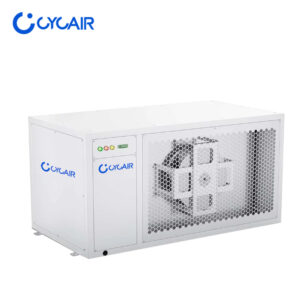
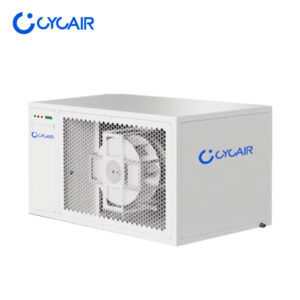
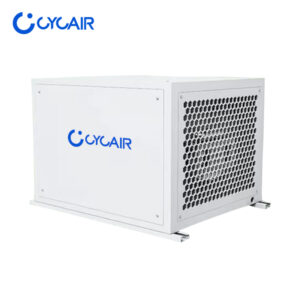
For this type of application, a product range such as Cycair DGR-A Series, including DGR-A210P, DGR-A380P, DGR-A500P, and DGR-A750P, provides different capacity options for different project sizes.
For the U.S. and Canadian markets, growers often expect product specifications in familiar units, including:
Using these units makes it easier for growers, contractors, and project buyers to evaluate the product.
The DGR-A Series is designed with North American grow room requirements in mind, which makes it easier to match commercial cultivation projects in the region.
Modern grow rooms often use automation systems. Humidity control may need to work together with HVAC, lighting, CO₂, and irrigation systems.
A dehumidifier with a low-voltage control interface can connect with third-party controllers, allowing the grower to manage humidity through a centralized system.
For example, Cycair DGR-A Series supports 24V control connection and can be integrated with mainstream systems such as TrolMaster and Honeywell.
A commercial grow room dehumidifier is designed for higher moisture loads, stronger airflow, continuous operation, and integration with grow room environmental control systems.
Pints per day shows moisture removal capacity. It helps growers compare different models and select a unit based on grow room moisture load.
For professional facilities, controller compatibility is very useful because it allows humidity control to work together with the overall grow room automation system.
If you are planning a commercial grow room or cannabis cultivation facility, share your room size, plant count, target humidity, and control system requirements.
Cycair can help recommend a suitable grow room dehumidification solution for your project.