
Choosing the right grow room dehumidifier is not just about selecting the largest unit available. A properly sized dehumidifier should match the room’s moisture load, airflow needs, operating conditions, and control strategy.
In North America, grow room dehumidifiers are usually evaluated using pints per day and CFM airflow. These two values are important, but they are not the only factors. Growers also need to consider plant density, growth stage, room design, energy performance, and controller compatibility.
This article explains the basic logic behind grow room dehumidifier sizing.
An undersized dehumidifier may run continuously and still fail to maintain target humidity. This can make the grow room unstable and increase operational risk.
An oversized unit may remove moisture too quickly in some conditions, consume more power than necessary, or increase upfront investment without matching the real project demand.
Proper sizing helps growers:
Pints per day describes how much moisture a dehumidifier can remove from the air in 24 hours under specific conditions.
In the U.S. and Canadian grow room market, this is one of the most common ways to compare dehumidifier capacity.
For example, a commercial grow room dehumidifier may be rated at 210, 380, 500, or 750 pints per day. A higher number means higher moisture removal capacity, but the right choice depends on the grow room conditions.
CFM means cubic feet per minute. It measures airflow.
A dehumidifier does not only remove moisture; it also moves air through the unit. In grow rooms, airflow helps the dehumidifier process room air and reduce humidity variation across the space.
Good airflow helps:
For large rooms, CFM becomes especially important because the dehumidifier must process enough air to affect the entire space.
A larger room usually needs greater moisture removal capacity. However, room size alone is not enough to determine the correct model.
More plants generally mean more transpiration. Larger plants release more moisture than smaller plants.
Vegetative and flowering stages usually create different moisture loads. Flowering rooms often require more careful humidity control.
More irrigation means more water entering the growing environment. Some of that water eventually becomes humidity.
Sealed rooms usually require stronger dehumidification because humidity is not easily exhausted outside.
Drying rooms need stable moisture removal, not just maximum removal speed.
Grow room dehumidifiers may operate for long hours. Energy performance matters because electricity cost can be significant in commercial cultivation facilities.
A high-efficiency design may include:
When comparing models, growers should consider not only the capacity but also the energy performance.
Sizing is not only mechanical. It also depends on how the dehumidifier is controlled.
A grow room dehumidifier that can connect with a third-party environmental controller can respond better to real-time humidity changes. This is important in commercial facilities where humidity, temperature, airflow, and HVAC systems are managed together.
A 24V control interface and compatibility with systems such as TrolMaster or Honeywell can make the dehumidifier easier to integrate into a complete grow room climate system.
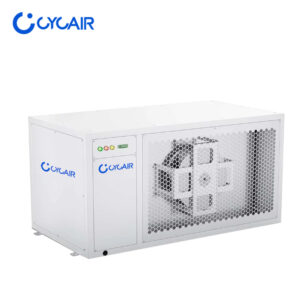
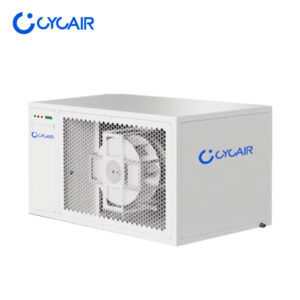
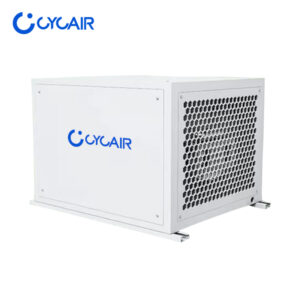
For commercial grow room applications, Cycair offers the DGR-A Series, with models such as:
These models provide different capacity options for different grow room scales. They can be selected based on pints per day, CFM airflow, room size, moisture load, and control requirements.
Before selecting a grow room dehumidifier, it is helpful to prepare the following information:
With this information, the supplier can recommend a more suitable model.
No. Pints per day is important, but CFM airflow, plant load, room layout, operating stage, and control system should also be considered.
It depends on room size, moisture load, airflow layout, and target humidity. Large rooms may require multiple units or higher-capacity models.
CFM helps buyers understand how much air the unit can process. This matters in grow rooms because airflow affects humidity distribution.
If you are not sure which model fits your grow room, Cycair can help with selection.
Send us your room size, plant count, target humidity, power supply, and control requirements. Our team can recommend a suitable grow room dehumidifier for your project.