
Humidity control is one of the most important parts of cannabis cultivation. In an indoor grow room, humidity is not just a comfort factor. It directly affects plant development, transpiration, airflow balance, and the stability of the growing environment.
Cannabis plants release moisture into the air throughout their growth cycle. As the plants grow larger, the amount of moisture released into the room increases. In sealed or semi-sealed grow rooms, this moisture can build up quickly if the space is not properly managed.
For professional growers, humidity control is not only about removing water from the air. It is about maintaining a stable environment that supports healthy plant growth, consistent crop quality, and efficient climate management.
A grow room is a controlled environment, but it is also a high-moisture environment. Several factors can increase humidity inside the room:
In a normal room, humidity may change slowly. In a grow room, humidity can rise quickly because plants are continuously releasing moisture into the air. The larger the canopy, the higher the moisture load.
This is why grow rooms need a planned humidity control strategy instead of relying only on ventilation or air conditioning.
Different cannabis growth stages require different environmental conditions. A stable humidity strategy should consider the plant’s development stage rather than using one fixed setting for the entire grow cycle.
Seedlings are young and delicate. At this stage, plants usually benefit from a more humid environment because their root systems are still developing. Sudden humidity changes can create stress and slow early growth.
The goal during this stage is to keep the environment stable and gentle.
During vegetative growth, plants grow quickly and produce more leaves. As leaf area increases, transpiration also increases. This means the room starts to generate more moisture.
At this stage, growers need stronger air circulation and better humidity management to keep the environment balanced.
The flowering stage usually requires more careful humidity control. Plants are larger, canopy density is higher, and moisture load can increase significantly.
Stable humidity during flowering helps growers maintain better environmental consistency and crop quality.
After harvest, drying and curing require controlled humidity and airflow. These stages are sensitive because the final quality of the crop depends heavily on stable environmental conditions.
Too much fluctuation can affect consistency. For this reason, drying and curing rooms often require dedicated dehumidification solutions.
Some growers try to use air conditioning to manage humidity. While air conditioning can remove some moisture, it is mainly designed for temperature control, not dedicated humidity control.
In a grow room, the moisture load may be too high for an air conditioner to manage efficiently. Also, if the cooling load and humidity load do not match, the room may still have unstable humidity even when the temperature looks acceptable.
A dedicated grow room dehumidifier is usually required when growers need continuous and predictable humidity control.
A suitable grow room dehumidifier should be designed for the real conditions of indoor cultivation. Important features include:
For North American grow room projects, buyers often check capacity in pints per day, airflow in CFM, power supply such as 208–230V / 60Hz, and controller compatibility.
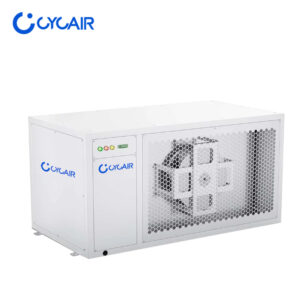
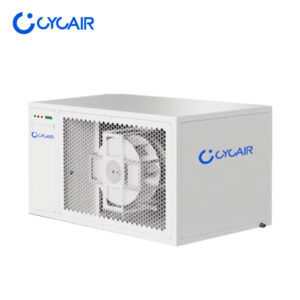
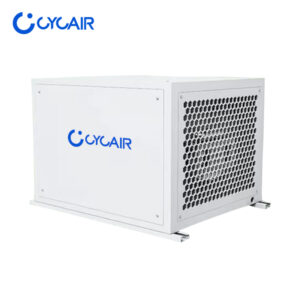
For grow room humidity control applications, Cycair offers the DGR-A Series Commercial Grow Room Dehumidifiers. This series is designed for cannabis cultivation, indoor farms, drying rooms, sealed grow rooms, and controlled environment agriculture facilities.
The series includes:
These models provide different capacity options for different room sizes and moisture loads. The DGR-A Series also supports EC fan technology, MERV 13 filtration, 24V third-party controller connection, and compatibility with control systems such as TrolMaster and Honeywell.
This allows growers to integrate dehumidification into a complete grow room climate control system.
Grow room humidity control solutions are suitable for:
The right model should be selected based on room size, plant density, target humidity, power supply, and control system requirements.
Cannabis plants release moisture through transpiration. As plants grow larger, they release more moisture, especially in sealed or high-density grow rooms.
Ventilation can help remove humid air, but in sealed rooms or commercial grow rooms, a dedicated dehumidifier is usually needed for stable humidity control.
Important factors include room size, plant count, target humidity, pints per day capacity, CFM airflow, energy efficiency, and controller compatibility.
If you are planning a grow room, drying room, or indoor cultivation facility, Cycair can help recommend a suitable humidity control solution.
Share your room size, plant count, target humidity, and power supply requirements, and our team will help you select the right grow room dehumidifier.