

A refrigerant dehumidifier is one of the most common types of dehumidification equipment used in homes, basements, warehouses, workshops, commercial buildings, and industrial spaces. It removes moisture from the air by cooling humid air below its dew point, allowing water vapor to condense into liquid water.
This working principle is similar to how water droplets form on the outside of a cold glass in a humid room. When warm humid air touches a cold surface, moisture in the air condenses. A refrigerant dehumidifier uses this same physical process in a controlled mechanical system.
Understanding how a refrigerant dehumidifier works helps buyers choose the right product for different humidity control applications.
A refrigerant dehumidifier is a dehumidification system that uses a refrigeration cycle to remove moisture from air. It usually includes several main components:
The main purpose of the system is to cool humid air, condense water vapor, collect or drain the water, and then return drier air back into the room.
Refrigerant dehumidifiers are widely used because they are efficient, practical, and suitable for many indoor environments where temperature is not extremely low.
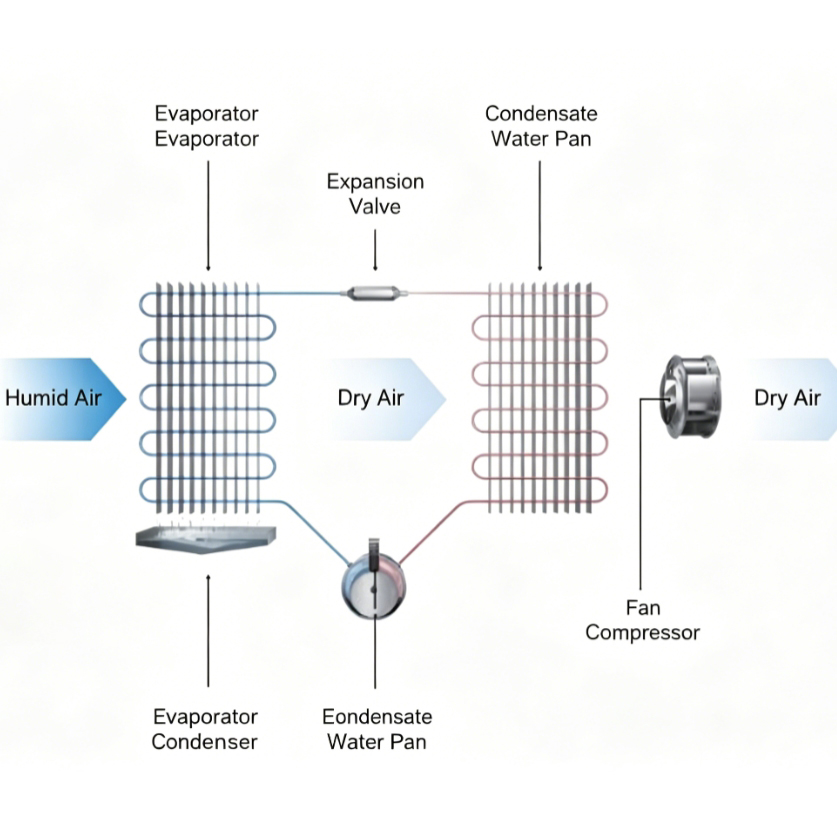
The process begins when a fan draws humid indoor air into the dehumidifier. Before the air reaches the heat exchanger, it usually passes through an air filter.
The filter helps reduce dust and particles entering the internal system. This is important because dust buildup on the evaporator or condenser can reduce heat exchange efficiency and affect long-term performance.
For commercial and industrial dehumidifiers, strong airflow is important because the equipment must process a large volume of air continuously.
After entering the unit, the humid air passes through the evaporator. The evaporator is the cold heat exchanger inside the dehumidifier.
Inside the evaporator, refrigerant absorbs heat from the air. As the air temperature drops, the air may reach its dew point. Once this happens, water vapor in the air begins to condense on the surface of the evaporator coil.
This is the key step of moisture removal.
The colder surface of the evaporator causes moisture in the air to change from vapor into liquid water.
As water vapor condenses on the evaporator coil, droplets form and flow down into a drain pan.
Depending on the dehumidifier design, the water may be:
For small portable dehumidifiers, a water tank may be convenient. For commercial, ceiling mounted, or industrial dehumidifiers, continuous drainage is usually preferred because it supports long-term operation without frequent manual water removal.
After moisture has been removed, the cooled air passes through the condenser. The condenser is the warm heat exchanger inside the dehumidifier.
The refrigerant releases heat through the condenser, and the air is reheated before it leaves the unit. This means the air leaving a refrigerant dehumidifier is usually drier and slightly warmer than the air entering the unit.
This reheating process is normal. It is part of the refrigeration cycle.
Finally, the fan sends the drier air back into the room. As the dehumidifier continues running, the indoor air repeatedly circulates through the unit.
Over time, more moisture is removed from the air, and the indoor relative humidity gradually decreases to the target range.
A humidity sensor or controller can monitor the room humidity and turn the dehumidifier on or off according to the setting.
The compressor is one of the most important components in a refrigerant dehumidifier. It compresses the refrigerant and drives the refrigeration cycle.
A reliable compressor helps the dehumidifier maintain stable performance. In commercial and industrial applications, compressor quality is especially important because the equipment may need to run for long periods.
Many commercial dehumidifiers also include compressor protection functions, such as delayed start protection, high and low pressure protection, and automatic defrost.
The evaporator and condenser are both heat exchangers, but they perform different functions.
The evaporator cools the incoming humid air and causes water vapor to condense.
The condenser reheats the air and releases heat from the refrigerant system.
The efficiency of these heat exchangers affects how quickly and effectively the dehumidifier removes moisture. Larger heat exchanger surfaces, hydrophilic aluminum fins, and optimized airflow design can improve condensation efficiency and dehumidification performance.
Airflow is critical in dehumidifier performance. If airflow is too weak, the unit cannot process enough humid air. If airflow is poorly designed, some parts of the room may remain humid while other areas become drier.
A good dehumidifier needs:
For warehouses, workshops, basements, and grow rooms, airflow is especially important because these spaces may be large or have uneven humidity distribution.
When the evaporator becomes very cold, frost may form on the coil, especially in lower-temperature environments. Frost can block airflow and reduce moisture removal efficiency.
An automatic defrost function helps remove frost from the evaporator and allows the system to continue operating safely and efficiently.
This feature is important for commercial dehumidifiers, basement dehumidifiers, ceiling mounted dehumidifiers, and industrial dehumidifiers that may operate in different temperature conditions.
Refrigerant dehumidifiers are widely used in many applications, including:
They are suitable for environments where the temperature is moderate and the goal is to remove moisture efficiently from indoor air.
A refrigerant dehumidifier removes moisture by cooling air and condensing water vapor.
A desiccant dehumidifier removes moisture using moisture-absorbing materials, such as a desiccant wheel or adsorption material.
In general:
For most commercial, basement, warehouse, and grow room applications, refrigerant dehumidifiers are practical and efficient.
When choosing a refrigerant dehumidifier, buyers should consider:
A small portable unit may be suitable for a basement or storage room. A ceiling mounted unit may be better for concealed installation. A floor standing industrial unit may be required for large warehouses or factories.
Cycair provides different refrigerant dehumidifier solutions for residential, commercial, industrial, underground, and grow room applications.
For flexible moisture control, DP-A to DP-F Series Portable Dehumidifiers can be used in basements, garages, storage rooms, workshops, and commercial spaces.
For floor standing large-capacity applications, DMC-A Series Floor Standing Industrial Dehumidifiers are suitable for warehouses, factories, underground spaces, and large commercial buildings.
For concealed installation, DCM-A Series Ceiling Mounted Dehumidifiers can be used in homes, basements, garages, storage rooms, warehouses, and industrial projects.
For cannabis cultivation and North American grow room applications, DGR-A Series Commercial Grow Room Dehumidifiers are designed for grow rooms, drying rooms, sealed rooms, and controlled environment agriculture.
A refrigerant dehumidifier cools the air inside the unit to condense moisture, but the air is reheated before being discharged. The outlet air is usually drier and slightly warmer than the inlet air.
The compressor drives the refrigeration cycle. It allows the refrigerant to absorb and release heat, making the condensation process possible.
Continuous drainage is not always necessary, but it is highly recommended for commercial, basement, ceiling mounted, and industrial applications where the dehumidifier may run for long periods.
Frost can form when the evaporator temperature is low. Automatic defrost helps remove frost and maintain stable operation.
If you need help selecting a refrigerant dehumidifier for a home, basement, warehouse, workshop, underground space, or grow room, Cycair can help evaluate your application.
Share your space size, temperature, humidity condition, drainage method, installation preference, and target humidity. Our team can recommend a suitable dehumidification solution.