
Warehouses are designed for storage, logistics, inventory management, and material protection. However, many warehouses face humidity problems because of large indoor areas, frequent door opening, poor air circulation, outdoor air infiltration, and temperature differences between indoor and outdoor environments.
When humidity is too high, a warehouse can become difficult to manage. Stored goods, packaging materials, equipment, metal parts, documents, and building structures may all be affected by unstable moisture conditions.
A professional warehouse humidity control solution helps create a drier and more stable indoor environment, making the warehouse easier to operate and maintain.
Humidity control in a warehouse is not only about comfort. It is directly related to storage quality, product protection, and operational stability.
Many warehouses store goods for weeks or months. If the indoor environment remains humid for a long time, moisture may affect packaging, cartons, labels, metal parts, electronic components, raw materials, textiles, wood products, and other humidity-sensitive items.
In some industries, stable humidity control is also important for quality management. A warehouse may need to maintain certain indoor conditions to protect goods before production, shipment, or distribution.
Warehouses often experience humidity problems because they are large and open spaces. Common issues include:
In large warehouses, humidity may not be evenly distributed. Some areas may be relatively dry, while corners, loading docks, underground areas, or poorly ventilated zones remain humid.
Different stored goods react to humidity in different ways.
Paper cartons, labels, and cardboard packaging can absorb moisture. This may reduce strength, affect appearance, and create handling problems.
High humidity can increase the risk of corrosion on metal components, tools, machinery, and stored equipment.
Electronics and electrical parts often require stable storage conditions. Moisture can affect packaging, circuits, connectors, and long-term reliability.
These materials are sensitive to moisture changes. Unstable humidity can affect shape, texture, and storage quality.
For many manufacturers and distributors, warehouse humidity control helps protect goods before shipment and reduce storage-related quality risks.
Ventilation can help remove stale air, but it does not always solve humidity problems. In humid climates, outdoor air may already contain a large amount of moisture. If this air enters the warehouse, indoor humidity may increase instead of decrease.
This is especially common in tropical, coastal, rainy, or high-humidity regions.
A dehumidifier directly removes moisture from the indoor air. For warehouse applications, dehumidification is often more reliable than ventilation alone, especially when stored goods require stable conditions.
A complete warehouse air control strategy may include:
A warehouse dehumidifier should be selected based on the space size, moisture load, stored goods, installation condition, and operation schedule.
Important equipment requirements include:
For larger warehouses, a small residential dehumidifier is usually not enough. Industrial dehumidifiers or high-capacity commercial dehumidifiers are more suitable.
Warehouse humidity control can use different types of dehumidifiers depending on the project.
Portable dehumidifiers are useful when the customer needs flexible moisture control. They can be moved between different zones, temporary storage areas, loading areas, or project sites.
They are suitable for warehouses that need flexible operation rather than fixed installation.
Floor standing industrial dehumidifiers are suitable for larger spaces and heavier moisture loads. They usually provide higher capacity, stronger airflow, and more stable long-term operation.
These units are commonly used in large warehouses, factories, workshops, storage centers, and logistics facilities.
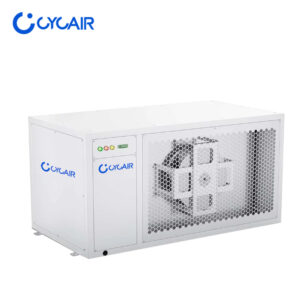
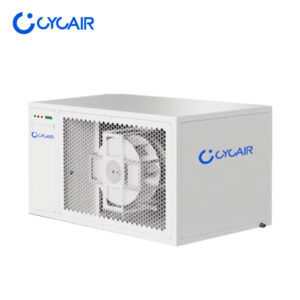
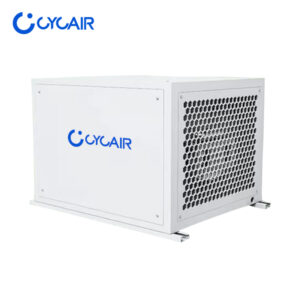
Ceiling mounted dehumidifiers are useful when floor space needs to be saved or when the system needs to be integrated into a building layout. They are suitable for warehouses, underground spaces, storage rooms, and commercial facilities where fixed installation is preferred.
For warehouse humidity control, Cycair provides different dehumidification options.
For large warehouse applications, DMC-A Series Floor Standing Industrial Dehumidifiers can be considered for high-capacity moisture removal and large-space humidity control.
For flexible and mobile use, DP-E Series Industrial Portable Dehumidifiers and DP-F Series Industrial Portable Dehumidifiers are suitable for warehouses, workshops, storage rooms, and commercial spaces that require movable dehumidification.
For projects where floor space is limited, DCM-A Series Ceiling Mounted Dehumidifiers can provide concealed or fixed installation for warehouse and storage applications.
The right product should be selected based on warehouse size, humidity level, storage type, drainage conditions, and installation requirements.
Warehouse humidity control solutions are suitable for:
Warehouse humidity may come from outdoor air infiltration, rainy seasons, poor ventilation, large open doors, ground moisture, temperature differences, and insufficient air circulation.
Ventilation may help in some cases, but if outdoor air is humid, it can make the problem worse. Dehumidification directly removes moisture from indoor air.
For large warehouses, floor standing industrial dehumidifiers or high-capacity ceiling mounted systems are usually more suitable. For flexible use, portable industrial dehumidifiers can be considered.
If you need humidity control for a warehouse, storage facility, or logistics space, Cycair can help recommend a suitable dehumidification solution.
Share your warehouse size, ceiling height, humidity problem, stored goods, and installation requirements, and our team will help select the right industrial dehumidifier for your project.